
Published · Updated
permitted development financePermitted Development Finance: A Guide for English Developers
By James Dawes, CeMAP, Founder, James William & Co Capital

Permitted development finance provides short to medium term funding for projects proceeding under permitted development rights without full planning permission, covering purchase and conversion costs while lenders manage risk through LTGDV limits, monitoring and clear exit requirements. It suits developers converting offices to flats or extending under householder rights. However, the deal only stacks up if prior approval status is sound and the exit is credible. For anything beyond a straightforward single scheme, a specialist broker structuring the debt tends to get better terms than approaching lenders directly.
TL;DR:
- Prior approval confirmation significantly influences loan size, pricing, and drawdown speed, often more than the borrower’s experience or exit strategy.
- Lenders typically cap financing at a percentage of the projected scheme value, adjusting for risk based on prior approval status, site specifics, and market comparables.
- Short-term bridging loans are suitable for schemes with minimal building work, while staged development finance is needed for projects involving structural or ground-up elements.
- Red flags such as Article 4 directions, conservation status, or previous approval refusals can disqualify or delay PD finance approval.
- Working with a specialist broker can streamline complex projects, secure better terms, and navigate timing issues related to prior approval and planning delays.
Table of Contents
- What is permitted development finance and how does it differ from standard funding?
- Which projects qualify: classes, prior approval and red flags
- How permitted development finance is structured
- What lenders check before approving a facility
- Costs, terms and how much you can borrow
- Timeline: how prior approval affects drawdown and scheduling
- When to instruct a specialist broker for PD finance
- Why prior approval status decides more than most developers realise
- How James William & Co Capital structures permitted development finance
- Where to verify permitted development rules
- Sources
- FAQ
What is permitted development finance and how does it differ from standard funding?
Permitted development rights let landowners carry out specific building works or changes of use without submitting a full planning application. The General Permitted Development Order 2015 sets out the statutory classes that qualify, and GOV.UK confirms that certain changes still require prior approval even though no full application is needed. Local authorities assess only the specific matters listed for that class. They cannot introduce fresh planning objections once a scheme falls squarely within PD rights.
That statutory certainty is exactly why lenders treat PD schemes differently from conventional development finance. A full planning consent carries months of committee risk, objection risk and the possibility of refusal on design or amenity grounds. A PD scheme, once prior approval is confirmed, has a much narrower set of unknowns. Lenders respond to that reduced uncertainty with shorter facilities, faster turnaround, and pricing that reflects a tighter risk window rather than a two-year build programme with planning still outstanding.
That does not mean PD finance is automatically cheaper. It means the risk lenders are pricing is different: less planning risk, more delivery and exit risk, because PD schemes are often conversions with tight margins and a narrower buyer pool than new-build family housing.
Three project types dominate the PD finance market in England:
- Commercial-to-residential conversions — offices, retail units and light industrial buildings converted to flats under Class MA and related classes.
- Agricultural conversions — barns and farm buildings converted to residential or commercial use.
- Householder extensions and outbuildings — loft conversions, rear extensions and garden buildings that fall within homeowner PD limits.
Each carries its own set of limitations and area-specific exclusions, which is where most PD finance applications either succeed quickly or stall for weeks.
Which projects qualify: classes, prior approval and red flags
Not every scheme calling itself “permitted development” will actually pass a lender’s due diligence. The class matters, the local authority’s prior approval decision matters, and any historic condition on the site matters. Get this wrong and you can lose weeks reworking a facility that was agreed on a false premise.
The GPDO classes that come up most often in PD finance applications:
- Class MA — commercial, business and service use (former Class E) converting to residential.
- Class Q — agricultural buildings converting to dwellinghouses.
- Class O and its successors — office-to-residential conversions, now largely folded into Class MA.
- Classes A to E (householder) — extensions, roof alterations and outbuildings for existing homes, detailed in GOV.UK’s householder technical guidance.
- Class MB and related change-of-use classes — smaller commercial changes that sometimes accompany a larger PD-led scheme.
Prior approval is the hinge point for lending decisions. It is not full planning permission, but it is the local authority’s formal confirmation that specific matters (transport, flooding, contamination, noise, and others depending on the class) have been considered and cleared. Most specialist lenders will not release full development funds until prior approval has been granted, not merely applied for. An application still pending leaves open the possibility of refusal or conditions that change the scheme’s viability, and lenders price that uncertainty into either a reduced facility or a delayed drawdown.
Pro Tip: If prior approval is still pending when you approach a lender, ask whether they will issue a conditional offer subject to approval rather than waiting to start the process from scratch. It can save three to four weeks on the overall timeline.
Watch for these red flags before you assume a scheme has PD rights at all:
- Article 4 directions — these remove specific PD rights in designated areas, often town centres or conservation zones, and are published by the local planning authority.
- Conservation area or listed building status — these frequently restrict or remove PD rights that would otherwise apply.
- Conditions on a previous planning permission — some past consents explicitly withdraw PD rights for that site, buried in condition wording that a quick title check will miss.
- Prior approval refusal history — a previous refusal on the same site changes how a lender views the current application, even under a different class.
How permitted development finance is structured
Two main facility types cover PD projects, and the right one depends on scale, timeline and how much construction risk is involved.
Bridging finance suits schemes with light conversion work, a straightforward change of use, or projects where the main value uplift comes from the change of use itself rather than heavy building work. Terms typically run from six to eighteen months, pricing is monthly, and there is usually no formal monitoring surveyor because there is limited construction to inspect.
Development finance suits schemes involving structural work, new floors, significant reconfiguration or ground-up elements within a PD envelope. These facilities release funds in staged drawdowns tied to build progress, verified by a monitoring surveyor at each stage. Terms usually run twelve to twenty-four months and pricing reflects the added construction and cost-overrun risk.

Mixed facilities blend the two: a bridging-style advance for acquisition and initial works, converting to a development-style drawdown schedule once the works phase begins. This suits schemes where the borrower is buying quickly under time pressure but knows a proper build programme follows.
Loan-to-gross-development-value, or LTGDV, is the metric that governs how much any of these facilities will actually lend. Lenders assess the projected value of the completed scheme, then cap borrowing at a percentage of that figure, commonly in a range that tightens as risk rises: less certainty over prior approval, a thinner comparable evidence base for the finished units, or a first-time developer all push the ceiling down. This is the single figure that determines whether your numbers work before a lender even looks at rates.
Facility structuring on PD schemes typically includes:
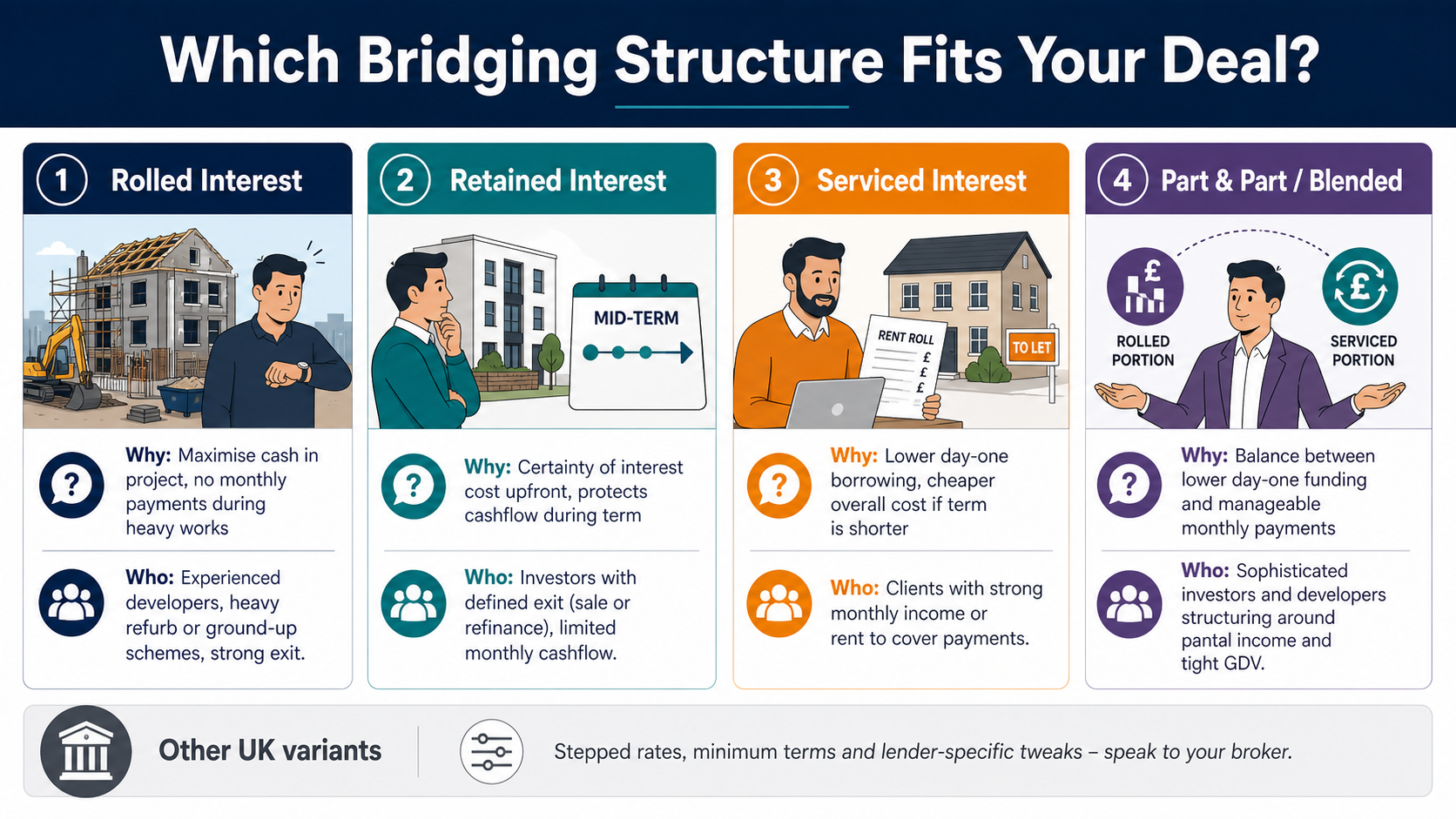
- Interest retained or serviced — many bridging facilities roll up interest so nothing is paid monthly, useful for cash flow during conversion.
- Monitoring surveyor sign-off — required before each drawdown on development-style facilities, confirming work matches the agreed programme and spend.
- Staged drawdowns — funds released against completed milestones rather than in one lump sum.
- Exit-linked covenants — some lenders build in step-up pricing or reduced flexibility if the agreed exit date slips.
Exit strategy shapes pricing more than almost any other factor. A sale on completion, a refinance onto a term mortgage, a forward sale agreed with a registered provider, or a joint venture partner taking a long-term stake, each carries a different risk profile in a lender’s eyes. According to research from Bayes Business School, specialist lenders and private credit funds carry a disproportionate share of short-term development lending precisely because they underwrite this exit risk more flexibly than mainstream banks, which tend to want a cleaner, more conventional repayment route before committing.
What lenders check before approving a facility
Lenders build their view of a PD scheme from four angles: the borrower, the numbers, the security, and the paperwork. Weakness in any one of these slows the process, even if the underlying project is sound.
Borrower track record comes first. A developer CV showing two or three completed schemes of similar scale carries far more weight than a polished business plan for a first project. Lenders will ask for previous project outcomes, including any that ran over budget or over time, because how you handled a problem tells them more than a scheme that went perfectly.
The numbers need to hold up to scrutiny beyond a one-page summary:
- A detailed budget broken down by trade, not a single contingency-inclusive lump figure.
- Contractor quotes, ideally from more than one source, for the main works packages.
- A realistic build programme with milestones that match the drawdown schedule you are requesting.
- A contingency allowance, typically expected in the region of 10 to 15% of build cost, plus a clear mobilisation plan for getting contractors on site quickly.
Security and valuation follow a slightly different path on PD schemes than on conventional development finance, because valuers must assess both the current use value and the projected value once the PD works or change of use complete. Lenders will also want confirmation of the monitoring surveyor’s terms of engagement before the facility completes, since that surveyor becomes their eyes on site for the life of the loan.
Documentation and legal conditions round out the checklist. Present prior approval confirmation or a lawful development certificate as early as possible in the process, not as an afterthought once heads of terms are agreed. Lenders will also ask about Community Infrastructure Levy exposure, since GOV.UK’s guidance makes clear that PD rights do not exempt a scheme from CIL liability depending on the local charging schedule and timing of commencement notices. Confirm CIL status with the local authority before finalising your facility size, because an unbudgeted CIL bill can eat into contingency fast.
Costs, terms and how much you can borrow
Pricing on PD finance varies enormously by lender risk appetite, scheme complexity and borrower track record, so treat any headline rate as a starting point for negotiation rather than a fixed number. Monthly rates on PD bridging facilities in England commonly sit in a range depending on loan-to-value, borrower experience and asset type, with development-style facilities carrying arrangement fees on top of the monthly or annualised rate.
Fees to budget for beyond the headline rate:
- Arrangement fee — typically charged as a percentage of the facility on drawdown.
- Monitoring surveyor fees — charged per site visit on development-style facilities, payable by the borrower.
- Valuation and legal fees — for both the lender’s valuer and the lender’s solicitor, in addition to your own legal costs.
- Exit fees — some lenders charge a fee on repayment rather than, or in addition to, the monthly rate.
- Retention provisions — a portion of the facility held back until practical completion or final sign-off is confirmed.
Facility sizes for PD schemes in England range from smaller householder-linked bridging loans through to multi-million-pound commercial-to-residential conversions, with the maximum available driven almost entirely by LTGDV headroom and the strength of the exit plan rather than a fixed lender ceiling.
If the borrower already owns the site outright, that facility covers conversion costs and fees; if purchase is still required, the lender will typically split the facility between day-one acquisition funding and staged works drawdowns, reducing what is available for the works themselves.
Timeline: how prior approval affects drawdown and scheduling
Sequencing is where PD-funded schemes most often come unstuck, not because the finance is unavailable but because the planning and lending clocks run on different timescales.
Local authorities have statutory determination periods for prior approval applications, and GOV.UK’s planning application statistics show actual decision times vary by authority and application volume, so build in a margin rather than assuming the fastest possible outcome. Most lenders will only release the bulk of a facility once prior approval is granted, not merely submitted, because a pending application still carries refusal risk that a granted one does not.
Three things determine how smoothly drawdown follows prior approval:
- Facility structure agreed in advance. A lender who has already reviewed the scheme and issued conditional terms subject to prior approval can move to full drawdown within days of the decision landing, rather than starting underwriting from scratch.
- Monitoring milestones mapped to the build programme. Development-style facilities release funds against surveyor-confirmed stages, so any slippage in the build programme delays the next drawdown, not just the completion date.
- A contingency route if approval is delayed or refused. Short bridging extensions, or restructuring the facility around a revised scheme that still qualifies for PD rights, are the two most common fallback positions.
Refusal or a lengthy delay does not automatically kill a scheme, but it changes the maths. A three-month delay on a facility charged monthly adds a real cost to the project, which is exactly why lenders build exit flexibility and step-in rights into the loan documents from the outset.
When to instruct a specialist broker for PD finance
Complex PD schemes rarely fit a single lender’s standard product. A commercial-to-residential conversion with a JV equity partner, an offshore holding structure, or a facility that needs to complete inside three weeks to beat a competing bidder, all need someone who already knows which lenders will say yes and on what terms.
Specialist brokers act as a capital concierge for complex situations: structuring bridging and development finance, mezzanine debt and JV equity across a network of family offices, private credit funds and specialist lenders, so the borrower deals with a single point of contact rather than chasing multiple lender relationships in parallel. That matters most where the debt stack has more than one layer, where speed under pressure is the deciding factor, or where a bespoke covenant package is needed to make a scheme viable at all.
Before instructing a broker, have ready: title documents, prior approval confirmation or the pending application reference, a detailed costed budget, contractor quotes, your own developer CV or company track record, and confirmation of how the exit is expected to work. The more of that is assembled upfront, the faster a broker can take a scheme to market and negotiate terms rather than spending the first fortnight gathering basics.
Why prior approval status decides more than most developers realise
Most guidance on permitted development finance treats prior approval as a box to tick alongside budget and contractor quotes. That undersells it. Prior approval status is the single variable that moves LTGDV, pricing and drawdown speed more than borrower experience, more than the strength of the exit plan, and often more than the asset class itself.
The conventional advice tells developers to get their budget and contractor quotes in order before approaching a lender. That is sound, but it is not the first job. The first job is establishing exactly where a scheme sits on the prior approval spectrum, because a lender’s whole risk model shifts depending on whether that status is granted, pending, or not yet applied for.
If you take one thing from this guide, make it this: resolve prior approval status before you build your finance case, not alongside it. A scheme with granted approval and a modest budget will move faster through underwriting than a well-costed scheme sitting on a pending application. Structure the finance conversation around that reality, not around the numbers alone.
— James William Dawes
How James William & Co Capital structures permitted development finance
Arranging PD finance directly with a single lender means accepting whatever terms that lender offers, even if a different fund would price the risk more favourably or move faster on drawdown. A specialist broker and debt structuring partner draws on a network of family offices, private credit funds and specialist lenders to find the facility that fits your scheme, whether that is straightforward bridging finance, a staged development facility, mezzanine debt to bridge an equity gap, or a JV equity arrangement for larger conversions.
An initial call typically covers scheme details, prior approval status, target LTGDV and your exit strategy, giving the firm enough to approach the right lenders rather than the widest possible list. For developers ready to move, James William & Co Capital’s specialist property finance team can review a scheme and outline realistic terms before you commit to a single lender’s standard product. Get in touch to request an initial review of your project.
Where to verify permitted development rules
Confirm any PD status or planning detail against primary sources before finalising a facility, not against a summary written by a third party.
- GOV.UK guidance on when planning permission is required, covering PD rights and prior approval generally.
- The Town and Country Planning (General Permitted Development) (England) Order 2015, the statutory basis for PD classes, and its Schedule 2 setting out the detailed class wording.
- GOV.UK technical guidance on householder permitted development rights.
- The FCA register, to confirm a lender’s regulatory status as part of due diligence.
Sources
FAQ
What is allowed under permitted development in the UK?
Permitted development rights allow specific building works and changes of use, such as certain commercial-to-residential conversions and householder extensions, without a full planning application, though many still require prior approval and remain subject to conditions set out in the GPDO 2015.
Can I lend my daughter money to buy a house?
Family loans for a house purchase are legally permitted in England, but most mortgage lenders require a signed declaration confirming whether the sum is a gift or a loan, since an undisclosed loan can affect the buyer’s mortgage affordability assessment.
Can you get 100% development finance?
Lenders very rarely fund 100% of a scheme’s costs; PD facilities are capped against loan-to-gross-development-value, commonly leaving the borrower to fund the remainder through equity, mezzanine debt, or a JV partner, which is where structured finance from a broker like James William & Co Capital often bridges the gap.
Are there any changes to permitted development rights in 2026?
Permitted development classes are periodically reviewed and amended by government, so always check the current version of the GPDO on legislation.gov.uk and GOV.UK’s guidance pages rather than relying on older summaries, since class limitations and eligible building types can change.
Recommended
Related Topics
Speak to a specialist
Discuss your finance with James directly
Whole-of-market specialist finance — bridging, development, commercial and residential. No call centres, no obligation. James reviews every enquiry personally.
New to specialist finance? How unbiased broker advice works · Deals we have completed
Explore Related Finance