
Published · Updated
why use development financeWhy Use Development Finance in UK Property
By James Dawes, CeMAP, Founder, James William & Co Capital

Nearly one in three british property developers cite misconceptions about development finance as a primary barrier to starting new projects. For seasoned professionals handling multi-million-pound transactions, understanding the risks and benefits of short-term funding strategies is critical. This guide unpacks how bespoke financial solutions give experienced developers and institutional investors a competitive edge in the United Kingdom’s complex real estate market.
Table of Contents
- Development Finance Defined And Misconceptions
- Types Of UK Development Finance Solutions
- How Development Finance Structures Work
- Key Benefits For Property Developers
- Risks, Costs And Regulatory Factors
- Comparing Alternatives To Development Finance
Key Takeaways
| Point | Details |
|---|---|
| Development finance is a tailored funding solution | It provides property developers with short-term loans that accommodate complex construction needs, unlike traditional mortgages. |
| Robust planning increases approval likelihood | Developers should prepare comprehensive project portfolios and clear exit strategies to enhance their chances of securing development finance. |
| Staged funding aligns with project milestones | Funding is released incrementally based on project progression, ensuring financial resources are available as needed throughout the development cycle. |
| Understanding risks and regulatory factors is essential | Developers must navigate financial risks and regulatory requirements carefully to avoid costly delays and ensure project viability. |
Development finance defined and misconceptions
Development finance represents a specialised short-term loan mechanism designed specifically for property development projects across the United Kingdom. These financial instruments enable property developers to fund complex construction and renovation initiatives that traditional mortgage products cannot accommodate.
At its core, development finance supports property developers by providing staged funding that covers critical project expenses, from initial land acquisition to final construction completion. Staged funding supports property development typically ranges from £250,000 upwards, with lenders requiring robust project plans, clear exit strategies, and demonstrable development expertise.
The landscape of development finance involves nuanced considerations that many inexperienced developers misunderstand. Government guidelines highlight specific financing requirements for developers, including mandatory controls such as securing controlling land interests and obtaining comprehensive planning consent. Common misconceptions include assumptions that all projects qualify automatically or that leasehold properties with complex ground rent structures will receive straightforward financing.
Key distinguishing factors of development finance include its short-term nature, higher interest rates compared to traditional mortgages, and the requirement for precise project management. Successful applicants typically demonstrate:
- Comprehensive project feasibility studies
- Detailed construction timelines
- Robust financial projections
- Proven track record in property development
Pro tip: Before applying for development finance, compile a comprehensive portfolio showcasing your previous development successes and detailed project plans to significantly improve your approval chances.
Types of UK development finance solutions
Property development financing in the United Kingdom encompasses a diverse range of specialised solutions tailored to meet the complex needs of real estate developers. Development finance solutions vary widely across different project scales, risk profiles, and investment strategies, offering flexible funding mechanisms for property professionals.
The primary types of development finance include ground-up construction loans, refurbishment finance, bridging loans, mezzanine finance, and equity finance. Ground-up construction loans provide comprehensive funding for entirely new property developments, covering land acquisition, construction costs, and associated project expenses. Refurbishment finance targets existing property renovation projects, enabling developers to transform and upgrade buildings with targeted capital injections.
Bridging loans represent short-term funding solutions designed for rapid property acquisitions or urgent refinancing needs. These quick-access financial instruments bridge temporal funding gaps, allowing developers to secure properties swiftly without protracted traditional lending processes. Mezzanine finance offers strategic funding that sits between senior debt and equity, providing additional capital for complex or high-risk development initiatives.
Key characteristics of development finance solutions include:
- Flexible funding structures
- Risk-adjusted interest rates
- Project-specific evaluation criteria
- Staged capital disbursement
- Customised repayment schedules
Pro tip: Consult multiple lenders and thoroughly analyse each development finance solution’s specific terms, ensuring the chosen mechanism aligns precisely with your project’s unique financial requirements and risk profile.
Here is a comparison of common development finance solutions for UK property developers:
| Finance Solution | Typical Use Case | Funding Speed | Capital Requirement |
|---|---|---|---|
| Ground-up Construction | New build projects | Moderate (weeks) | High (land & build costs) |
| Refurbishment Finance | Upgrading existing properties | Moderate (weeks) | Medium (renovation costs) |
| Bridging Loan | Fast acquisitions/refinancing | Very fast (days) | Variable (short-term) |
| Mezzanine Finance | Large, complex schemes | Moderate to slow | High (supplements debt) |
| Equity Finance | Shared risk, large projects | Slow (negotiations) | Significant (ownership) |
How development finance structures work
Development finance structures represent intricate financial mechanisms designed to support property developers through complex project lifecycles. Phased funding approaches enable strategic capital deployment across different project stages, ensuring developers have precise financial resources when needed.

The typical development finance structure involves a carefully orchestrated process of capital release, known as drawdown facilities. These facilities allow developers to access funds incrementally, with each financial tranche tied directly to specific project milestones. Lenders typically conduct rigorous quarterly inspections or milestone-based assessments to verify project progression, releasing subsequent funding only after confirming satisfactory development advancement.
Financial risk management sits at the core of development finance structures. Lenders implement comprehensive monitoring mechanisms to protect their investment, including detailed project appraisals, regular site inspections, and strict performance criteria. Repayment strategies are predominantly structured around two primary exit routes: selling completed development units or refinancing the project with longer-term financial instruments. This approach ensures developers maintain clear accountability and provides lenders with multiple risk mitigation strategies.
Key components of development finance structures include:
- Structured drawdown mechanisms
- Milestone-linked funding releases
- Comprehensive project monitoring
- Flexible repayment frameworks
- Risk-adjusted interest calculations
Pro tip: Prepare meticulous project documentation and maintain transparent communication with your lender, as this significantly enhances your chances of securing smooth, staged funding releases throughout your development project.
Key benefits for property developers
Development finance offers property developers a strategic toolkit for transforming ambitious real estate concepts into tangible, profitable projects. Property development strategies enable developers to overcome traditional financial constraints, providing flexible capital solutions that traditional banking mechanisms cannot match.
One of the most significant advantages of development finance is the ability to unlock project potential through staged funding mechanisms. Unlike conventional lending, these specialised financial instruments allow developers to access capital precisely when needed, matching funding directly to project milestones. This approach minimises interest exposure, reduces financial risk, and provides developers with greater financial agility to respond to unexpected challenges or opportunities during the development process.
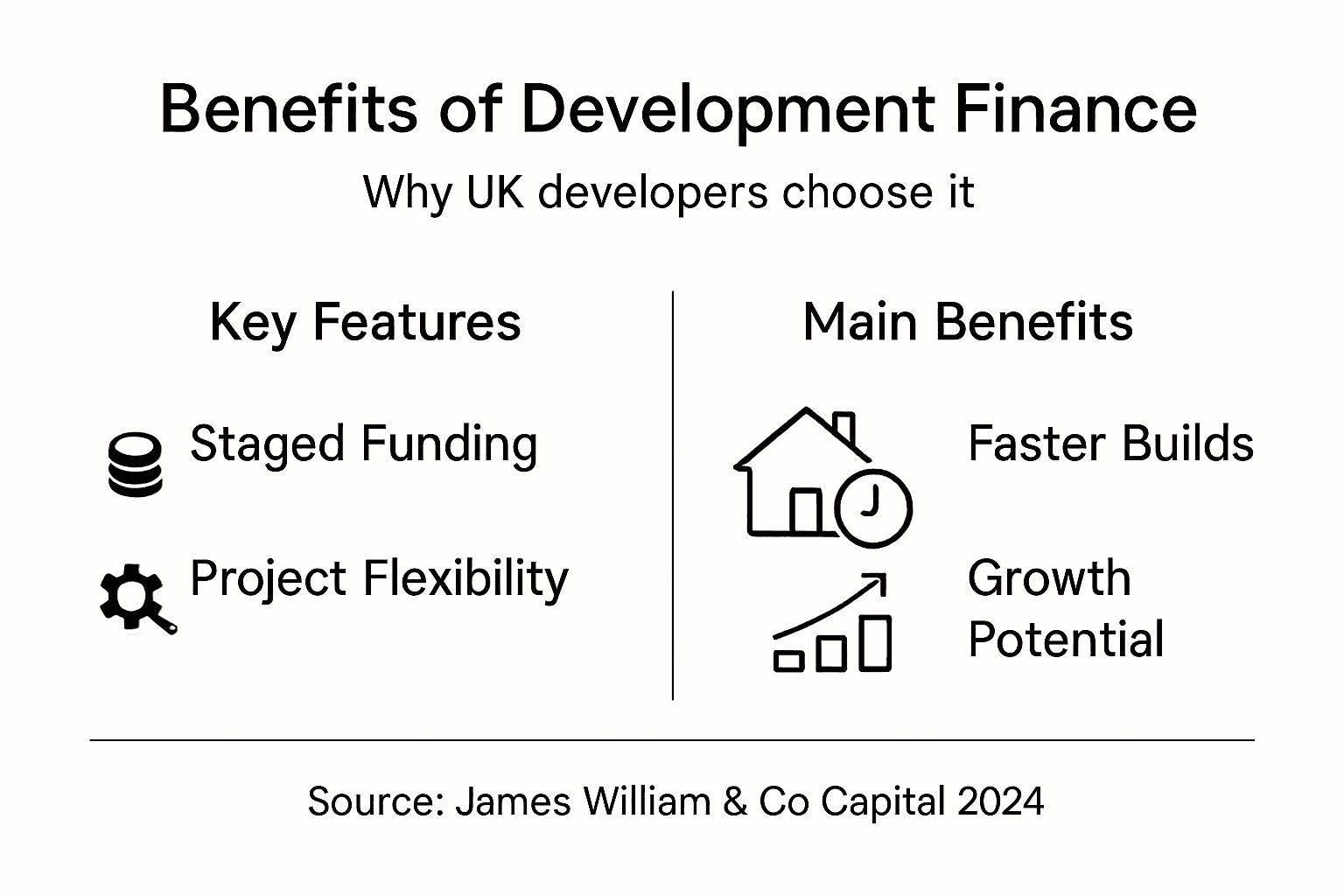
Moreover, development finance solutions offer developers unprecedented flexibility in project structuring. These financial products can be tailored to accommodate complex project requirements, including ground-up construction, extensive renovations, and multi-phase developments. The bespoke nature of these financing mechanisms means developers can secure funding for projects that might be considered too risky or unconventional by traditional lenders, thereby expanding their potential investment opportunities.
Key benefits for property developers include:
- Flexible, milestone-based funding
- Reduced upfront capital requirements
- Customised repayment structures
- Enhanced project feasibility assessment
- Faster project initiation and completion
Pro tip: Develop a comprehensive and transparent project proposal that clearly demonstrates your development expertise, potential return on investment, and detailed exit strategy to maximise your chances of securing development finance.
Risks, costs and regulatory factors
Development finance presents a complex landscape of financial risks, regulatory requirements, and intricate cost structures that demand comprehensive understanding from property developers. Property finance regulations require meticulous attention to detail and strategic financial planning to navigate potential challenges effectively.
The primary financial risks associated with development finance stem from market volatility, construction uncertainties, and potential delays in project completion. Interest rate fluctuations can significantly impact project profitability, with development loans typically carrying higher interest rates compared to traditional mortgage products. Developers must carefully assess their risk exposure, considering factors such as construction timelines, market demand, and potential economic shifts that could compromise project viability.
Regulatory compliance represents another critical dimension of development finance. Property developers must navigate a complex framework of planning permissions, building regulations, environmental standards, and financial reporting requirements. These regulatory constraints can introduce additional costs and potential delays, necessitating a proactive approach to compliance management. Lenders typically conduct rigorous due diligence, examining project feasibility, developer experience, and comprehensive risk mitigation strategies before committing financial resources.
Key risk and cost considerations include:
- Market value fluctuations
- Construction timeline uncertainties
- Regulatory compliance expenses
- Interest rate volatility
- Potential project overruns
Pro tip: Conduct comprehensive financial modelling that includes stress-testing scenarios, allowing for potential market fluctuations and regulatory challenges to ensure robust project financial resilience.
The following table highlights key risk and regulatory factors affecting development finance projects:
| Factor | Impact on Project | Mitigation Strategy |
|---|---|---|
| Market Volatility | Can erode profit margins | Conservative financial planning |
| Construction Delays | Increase overall project costs | Robust project management |
| Interest Rate Fluctuations | Elevates borrowing expenses | Fixed-rate or hedging agreements |
| Regulatory Approval Delays | Cause costly project setbacks | Early permissions and compliance |
| Cost Overruns | Threaten financial viability | Detailed budgeting and monitoring |
Comparing alternatives to development finance
Property developers have multiple financing options beyond traditional development finance, each with distinct advantages and limitations. Financing alternatives comparison reveals nuanced strategies that can complement or potentially replace development finance depending on project specifics.
Bridging loans represent a swift alternative, offering rapid capital injection for time-sensitive property acquisitions. However, these financial instruments typically carry significantly higher interest rates and require a clear, robust exit strategy. Commercial mortgages provide lower interest rates but are exclusively available for completed or income-generating properties, making them unsuitable for projects in active construction phases. This limitation underscores the unique positioning of development finance in supporting projects from inception to completion.
More sophisticated alternatives include joint venture financing and mezzanine debt, which offer flexible arrangements combining different proportions of debt and equity. These structures allow developers to access capital while potentially sharing project risks and rewards with investors. Mezzanine finance, positioned between senior debt and equity, can provide additional funding layers for complex development initiatives, though it often comes with more stringent performance requirements and higher associated costs.
Key comparative factors include:
- Speed of capital access
- Interest rate structures
- Repayment flexibility
- Risk allocation
- Funding stage compatibility
Pro tip: Conduct a comprehensive financial analysis comparing multiple funding alternatives, considering not just immediate capital requirements but long-term project economics and risk management strategies.
Unlock Your Project’s Potential with Expert Development Finance Solutions
Navigating the complexities of development finance in the United Kingdom can be challenging, especially when facing market volatility, strict regulatory requirements, and intricate funding structures. If you are a property developer striving to secure flexible, milestone-based funding while managing risks and optimising your project timeline, it is essential to partner with a specialist who understands your unique needs. The article outlines critical aspects such as structured drawdown mechanisms, staged capital disbursement, and the importance of a robust exit strategy — all vital elements that can determine your project’s success.
At James William & Co Capital, we specialise in bespoke development finance and debt structuring tailored for sophisticated UK property projects. Our capturing multi-layered funding solutions combine bridging loans, mezzanine finance, and equity arrangements customised to suit your specific development goals. We provide a capital concierge style service ensuring rapid execution even under tight deadlines, so you can focus on delivering outstanding developments. Take control of your project financing today and discover how our expert team can turn your development ambitions into reality. Visit us at James William & Co Capital to start your journey towards securing the right funding solution.
Frequently Asked Questions
What is development finance?
Development finance is a specialised short-term loan mechanism designed to fund property development projects, covering expenses from land acquisition to construction completion.
How does development finance differ from traditional mortgages?
Development finance is typically short-term, has higher interest rates, and offers staged funding tied to project milestones, whereas traditional mortgages are long-term loans generally used for completed properties.
What types of projects can benefit from development finance?
Development finance can be used for various projects, including ground-up construction, refurbishment of existing properties, and complex developments requiring multiple funding sources.
What factors do lenders consider when approving development finance?
Lenders evaluate comprehensive project feasibility studies, detailed timelines, financial projections, developer experience, and risk profiles to determine approval for development finance.
Recommended
Related Topics
Speak to a specialist
Discuss your finance with James directly
Whole-of-market specialist finance — bridging, development, commercial and residential. No call centres, no obligation. James reviews every enquiry personally.
New to specialist finance? How unbiased broker advice works · Deals we have completed
Explore Related Finance